Havent seen the movie yet but i trust Terry has made another masterpiece... Havent read the stolen article either, lazy lazy. But They are usually entertaining and informative.
http://vigilantcitizen.com/?p=3486
“The Imaginarium of Doctor Parnassus” and Heath Ledger’s Sacrifice
Apr 5th, 2010 | By Vigilant | Category: Vigilant Reports Heath Ledger’s last movie is a mind-boggling one. From its enigmatic storyline to the mysteries surrounding its production, “The Imaginarium of Doctor Parnassus” deserves to be duly explored. An interpretation of its rich symbolism reveals to the viewers timeless esoteric truths as well as coded references to today’s occult cryptocracy. This article looks at the mystical meaning of the “The Imaginarium of Doctor Parnassus” and the sacrificial nature of Heath Ledger’s death.
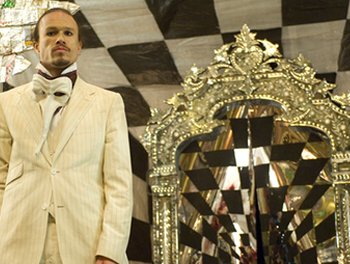
It seems the last movies of actors who die prematurely are often heavily symbolic. A single viewing of the trailer for The Imaginarium of Doctor Parnassus was sufficient to convince me of the movie’s deep esoteric undertones. Terry Gilliam’s productions have often dealt with occult themes, but this one seemed unusually flagrant. I was therefore looking forward to the movie’s reviews and the potential discussions it would engender. However, I found nothing but superficial blurbs and critiques talking about a “fantastic adventure” or something of the sort. So I watched the movie to see if I misjudged the trailer and, after the first minute and a half, all of my doubts evaporated. The movie begins with a man (Anton) dressed as Mercury (“Hermes” of the Greeks and “Thoth” of the Egyptians) announcing Dr. Parnassus, who is dressed as a monk, holding a lotus flower, a symbol of Eastern mysticism. Pretty esoteric. We’ll first look at the underlying meaning of the movie and follow with the strange symbols relating to Heath Ledger’s death.
The Esoteric Meaning of the Story
The premise of The Imaginarium of Doctor Parnassus conceals a meaning for those who, in the words of Anton playing Mercury, have “eyes to see and ears to hear”. Here’s a quick summary of the movie.
“The Imaginarium of Doctor Parnassus is a fantastical morality tale, set in the present day. It tells the story of Dr. Parnassus and his extraordinary ‘Imaginarium’, a traveling show where members of the audience get an irresistible opportunity to choose between light and joy or darkness and gloom. Blessed with the extraordinary gift of guiding the imaginations of others, Dr. Parnassus is cursed with a dark secret. Long ago he made a bet with the devil, Mr. Nick, in which he won immortality. Many centuries later, on meeting his one true love, D.r Parnassus made another deal with the devil, trading his immortality for youth, on condition that when his first-born reached its 16th birthday he or she would become the property of Mr. Nick.
Valentina is now rapidly approaching this ‘coming of age’ milestone and Dr. Parnassus is desperate to protect her from her impending fate. Mr. Nick arrives to collect but, always keen to make a bet, renegotiates the wager. Now the winner of Valentina will be determined by whoever seduces the first five souls. Enlisting a series of wild, comical and compelling characters in his journey, Dr. Parnassus promises his daughter’s hand in marriage to the man that helps him win. In this captivating, explosive and wonderfully imaginative race against time, Dr. Parnassus must fight to save his daughter in a never-ending landscape of surreal obstacles – and undo the mistakes of his past once and for all.”
-IMDB
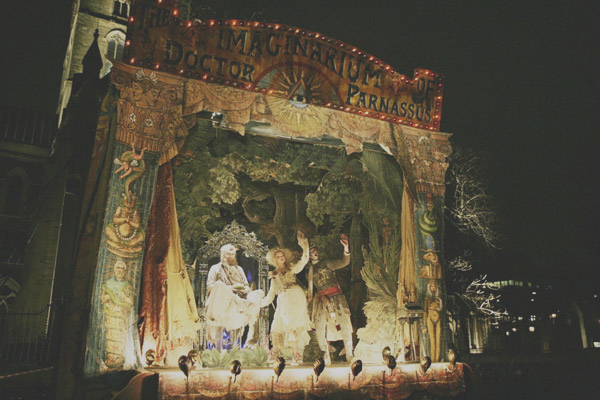
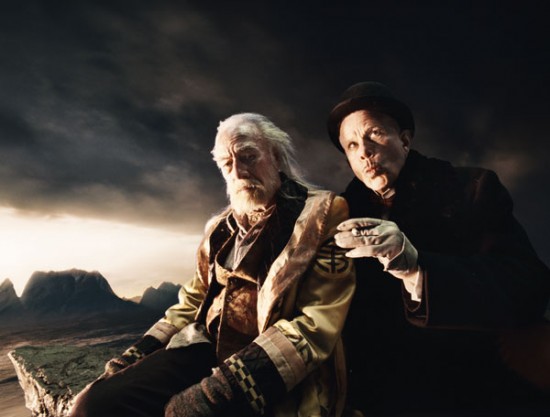
The storyline revolves around a classic Faustian theme, in which Dr. Parnassus makes various bets with the Devil (played by Tom Waits) throughout his life. Looking deeper into the symbolism of the story, Dr. Parnassus and his traveling show are a metaphor for the esoteric teachings transmitted through the ages via Mystery schools. He is a human manifestation of the “path to enlightenment” of the Buddhists or the “inner-Christ” of the Gnostics. By inviting people into the magic mirror, he transports them onto the spiritual plane where they can choose between spiritual fulfillment and enlightenment (represented by a pyramid or a ladder, depending on the person) or ignorance and materialism (represented by a pub or a sleazy motel). Dr. Parnassus says “he transmits the story that sustains the universe,” which is a poetic way of saying that he is the vehicle for the secret teachings leading to illumination. He provides the path that allows the communion between humanity and divinity. The entire symbolism surrounding Paranassus’ theater is inspired by the esoteric teachings of the ancient Egyptians, Greeks, Buddhists and other esoteric schools. The stage contains many interesting occult symbols.
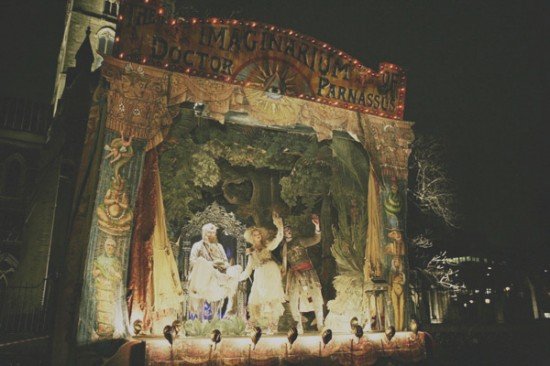
- From Janus, the two-headed Greek god to the Masonic twin pillars and the All-Seeing Eye, Dr. Paranassus’ stage reveals the spiritual nature of the theater
Parnassus’ name is also a reference to occult initiation. His name is derived from Mount Parnassus, the sacred mountain of the Dionysus, the Greek god of mystery religious rites (also known as the roman Bacchus). Mount Parnassus also contained the famed oracle of Delphi, the mystical site where people could obtain spiritual revelations.
Dealing with the Devil
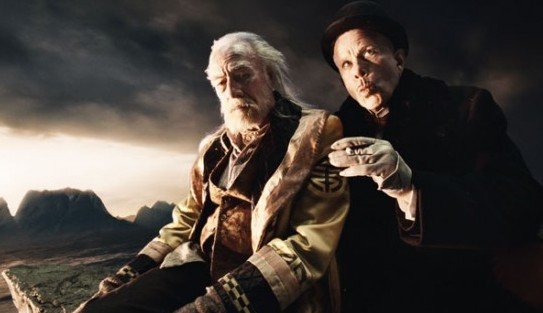
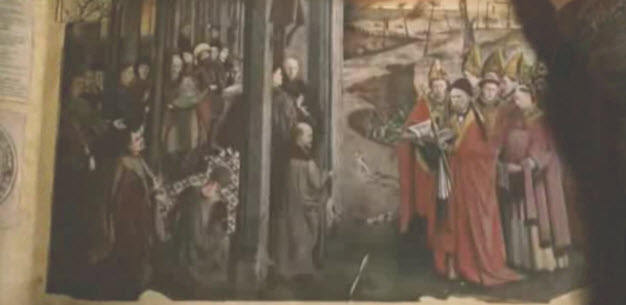
As stated above, the story of the immortal Dr. Parnassus is analogous with the evolution of the Mysteries throughout History. This story was not always perfect and numerous influences have altered its course. There is a constant exchange in the movie between Dr. Parnassus and the Devil and it ultimately becomes evident that they actually need each other in order to exist and to stay relevant. Through their back and forth, they reenact the ancient principle of duality, the constant struggle opposing good versus evil and light versus darkness. This concept is visually represented by the Masonic black and white checkerboard pattern. While explaining his dealings with the Devil to his daughter, Dr. Parnassus explains in coded terms the nature of his essence. It can be found within Buddhist monks, in Jesus Christ and even in Freemasonry. He describes his first bet with the Devil as a competition to see who could first attract twelve disciples. Dr. Parnassus shows his daughter a book containing symbolic images.
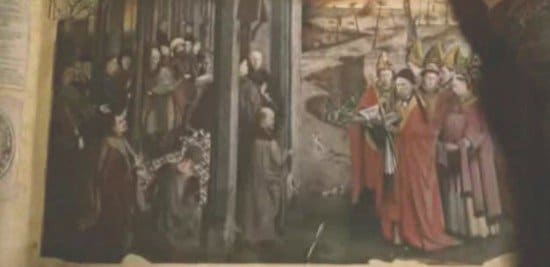
- The Devil is here shown surrounded by clergymen. Parnassus says he uses the “necessities of danger, fear and the fabled bliss of ignorance” to attract disciples.
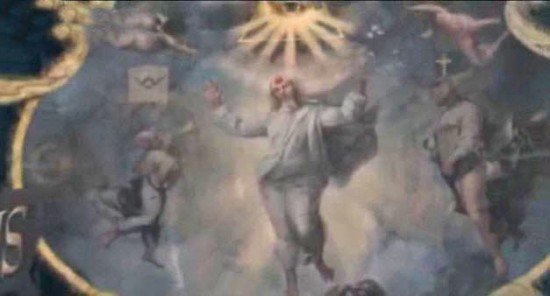
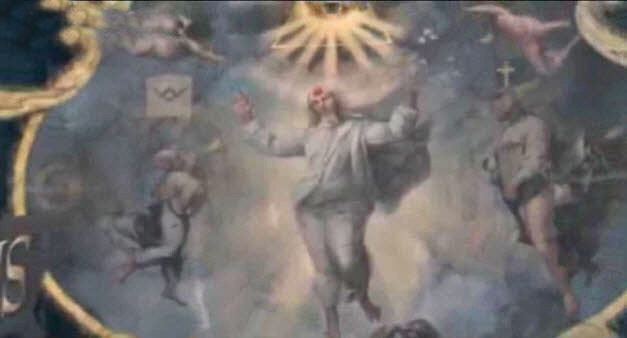
- Parnassus teaches “the power of the imagination to transform and illuminate our lives”. He is here depicted as Jesus Christ with his third eye open, floating under the Eye of the Great Architect. Notice on the left a symbol that is very similar to a Masonic square and compass.
Parnassus won that first bet, but he was tricked: the Devil let him win. The Devil knew that, in due time, “nobody would want to hear Parnassus’ stories”. In other words, the Devil knew the world would spiral back into ignorance, ultimately finding itself in the spiritual state we are in today. Parnassus’ show (a metaphor for the path to Illumination) is now a strange novelty, a road-side curiosity that is ignored by most everyday people who are too busy to ponder on its teachings. Then comes Tony.
Tony Liar
Found by Parnassus’ traveling troupe hanging under a bridge, Tony Liar (whose name is based on British Prime Minister Tony Blair) may or may not have been sent by the Devil. Despite his mysterious past, Tony is integrated into to the show and he quickly uses his charming yet dishonest ways to attract more people to the show. He is, however, focused on generating more money and is not interested in people’s spiritual salvation. He finally convinces Parnassus to change the style of the show to make it more modern and to change the audience to make it more … rich.
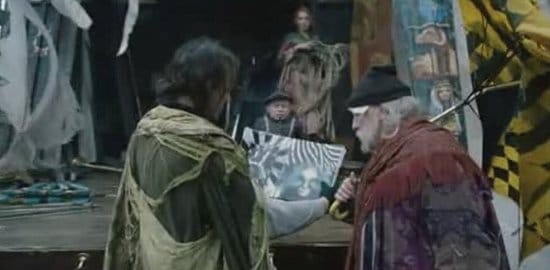
- To illustrate his point about being modern, Tony shows Parnassus a photo in a magazine of a girl making the “a-ok” sign in front of her eyes … interesting.
Tony tells Parnassus not to hide his “mind control thing”, to be bold and to reach the right kind of public. This is the result:
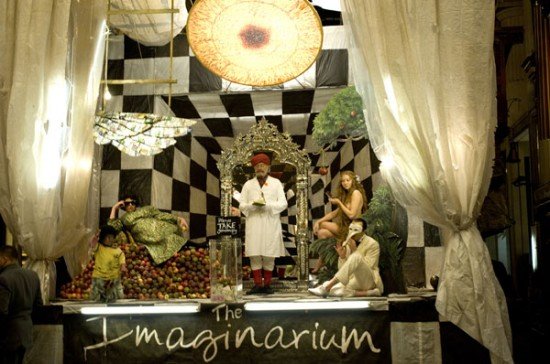
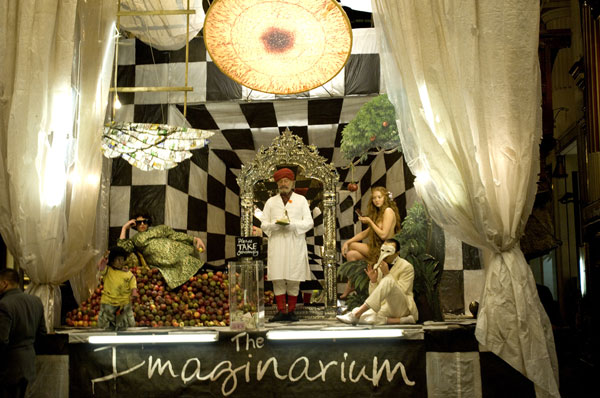
- A tri-dimensional Masonic checkerboard pattern leads the way to the “magic mirror”, the gateway to the spiritual plane. Did Freemasonry “repackage” the ancient Mysteries in a way that would be attractive to the upper-class?
The new stage is set in an elegant shopping mall. There is also a change of philosophy: instead of asking for donations, there is box filled with money stating “Please Take Generously”. The bold marketing ploy pays off and those who experience the “other side of the mirror” come back totally fulfilled, leaving behind their money, fur coats and jewelry.
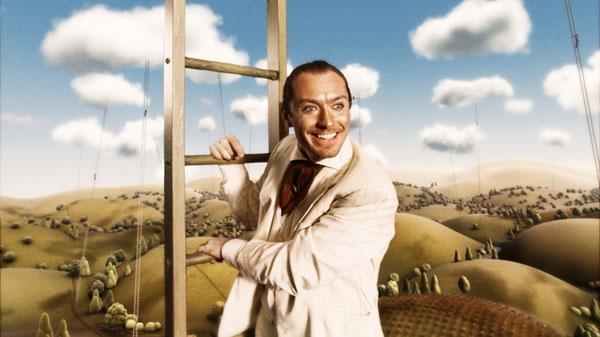
Tony himself finally experiences the joys of the spiritual plane and finds himself climbing the ladder to Illumination.
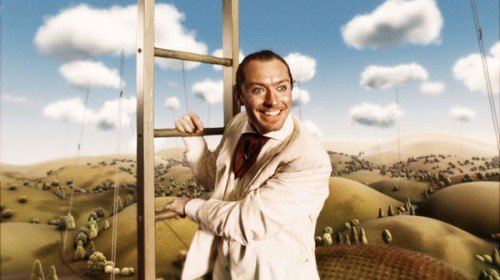
- Tony is here played by Jude Law, one of the three actors who replaced Heath Ledger after his premature death.
His climb is stopped however by his troublesome past (the Russian mafia) catching up to him, and the ladder breaks. Spiritual enlightenment cannot be obtained by just anyone. He has however tasted the feeling of “being like a god”.
Heath Ledger’s Sacrifice
While The Imaginarium of Doctor Parnassus communicates an inspiring spiritual message, there is a rather grim side to the movie that relates to Heath Ledger’s death. The concept of duality is present within the movie itself where the tales of illumination are mixed with references to black magic and sacrificial death. Good and evil struggle again. The numerous references to death during the movie could be interpreted as a tribute to Heath Ledger, but, as Terry Gilliam states, none of the script was rewritten after the tragedy. Here is an excerpt of the director’s interview with Last Broadcast:
The film is terribly poignant film to watch now because of the loss of Heath.
Yes, it is.
And there are the references to death in the film that seem terribly poignant in the light of what happened. Did you re-emphasise any of that after his death?
The references to death were all in the original script, which people don’t understand. They all thought we had written this stuff after Heath had died and no, we didn’t change any of the words. And that to me is what’s so kind of scary and spooky – why was it so prescient? It seemed to be all about death, it’s so much of it.
Source
Not only there are many references to death, there are many references to sacrificial death. Knowing the odd circumstances in which Ledger lost his life, could his death be the result of a ritual sacrifice? Are there codes within the movie relating to it? This might sound improbable to the average person but, to the initiate of the occult practices of the entertainment industry, it is a definite possibility. The observations presented here might be coincidences or they might be signs placed on purpose. One thing is for sure: they are there. The first person that seemed freaked out by this was the director himself, who was apparently a friend of Ledger. In his interview with Sun Media, Gilliam stated:
“There are forces at work on this film, don’t get me into my mystical mode … but the film made itself and it was co-directed by Heath Ledger!”
Why is he implying that other forces were at work during the creation of this movie?
The Hanged Man
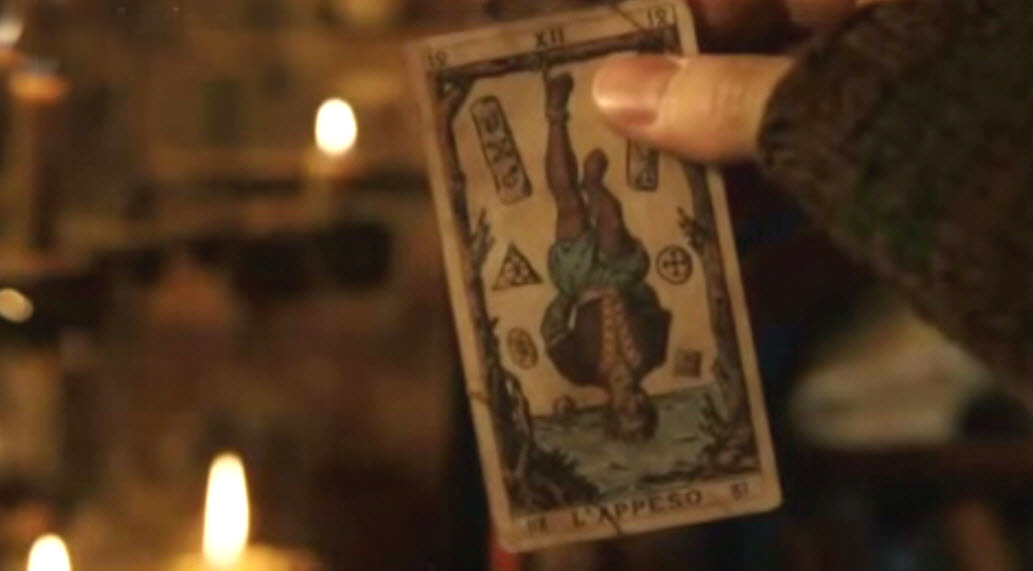
Right before the traveling troupe finds Tony hanging under a bridge, Dr Parnassus pulls out the Tarot card of the Hanged Man. It predicted what was about to happen but the occult significance of the card is even more relevant:
“Esoterically, the Hanged Man is the human spirit which is suspended from heaven by a single thread. Wisdom, not death, is the reward for this voluntary sacrifice during which the human soul, suspended above the world of illusion, and meditating upon its unreality, is rewarded by the achievement of self-realization.”
- Manly P. Hall, The Secret Teachings of All Ages
The Hanged Man indeed refers to the myth of the dying god who is committing the ultimate sacrifice in order to attain immortality.
“There is present in the rituals similarities of concepts or beliefs. In the ancient tradition it was believed that through the connection of the body and blood of the Slain God that the people became one with the deity. In the “Last Supper” Jesus declare that the bread and wine were his body and blood, which he gave up for the salvation of the people. Blood was believed to contain the life force. The death of the king freed the inner spirit. Through the distribution of his body and blood, heaven and earth were united and his vital energy renewed the kingdom.
The appearances of the Slain God have taken on various aspects throughout the ages. His images can be seen in the Jack-in-the-Green, the Hooded Man, the Hanged Man of the Tarot, the Lord of Vegetation, the Harvest, and the free untamed aspect of the forest.”
- Source
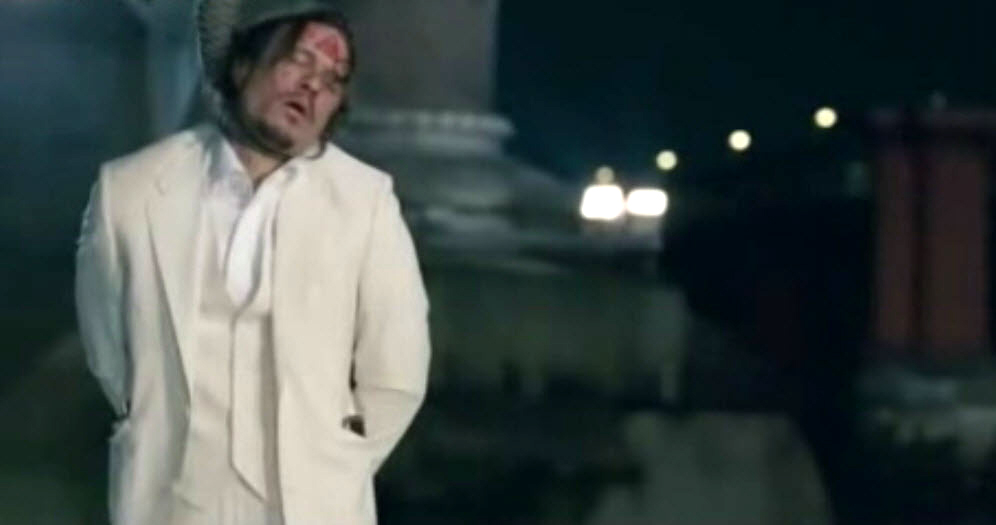
Anton and Valentina then find Tony hanging beneath Blackfriars Bridge.
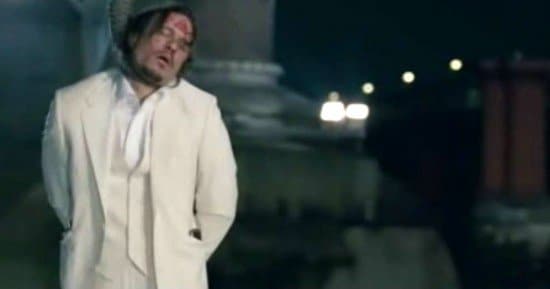
- Ledger’s previous movie was The Dark Knight in which he played The Joker – The Fool of the Tarot. Did The Fool evolve into the Hanging Man?
This scene is inspired by the actual 1982 hanging of Roberto Calvi (dubbed “God’s banker” due to his relations with the Vatican). The hanging took place under the exact same bridge. Although never publicly confirmed, there are strong theories that Roberto Calvi’s death was a symbolic and ritualistic murder carried out by the black masonic lodge called Propaganda Due, also referred to as P2. The name of the bridge is very significant:
“Mr. Calvi’s investigation indicates that his father was strangled, before his body was weighted and suspended underneath Blackfriars Bridge, probably by people who were in a small boat. The choice of bridge may have been significant: the P2 members referred to themselves as “frati neri” – black friars.”
-Source
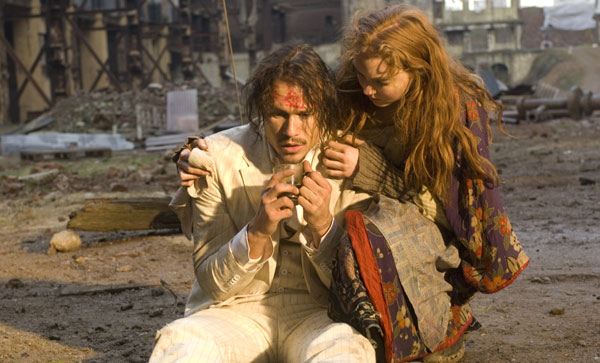
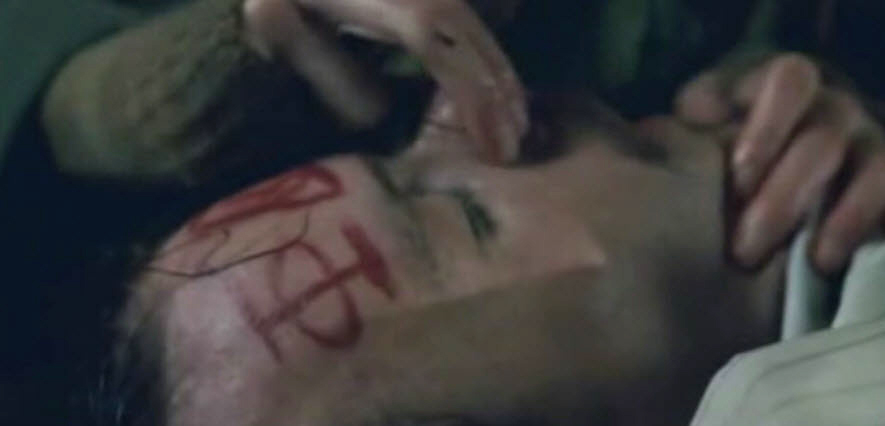
Tony’s forehead bears strange occult markings, as if to further the sense of ritualistic murder in the minds of the viewers.

- Phi is a Greek letter representing the Golden Ratio, a mathematical proportion that is extremely important in Freemasonry.
Why did the directors pay homage to this symbolic murder?
Dying Young
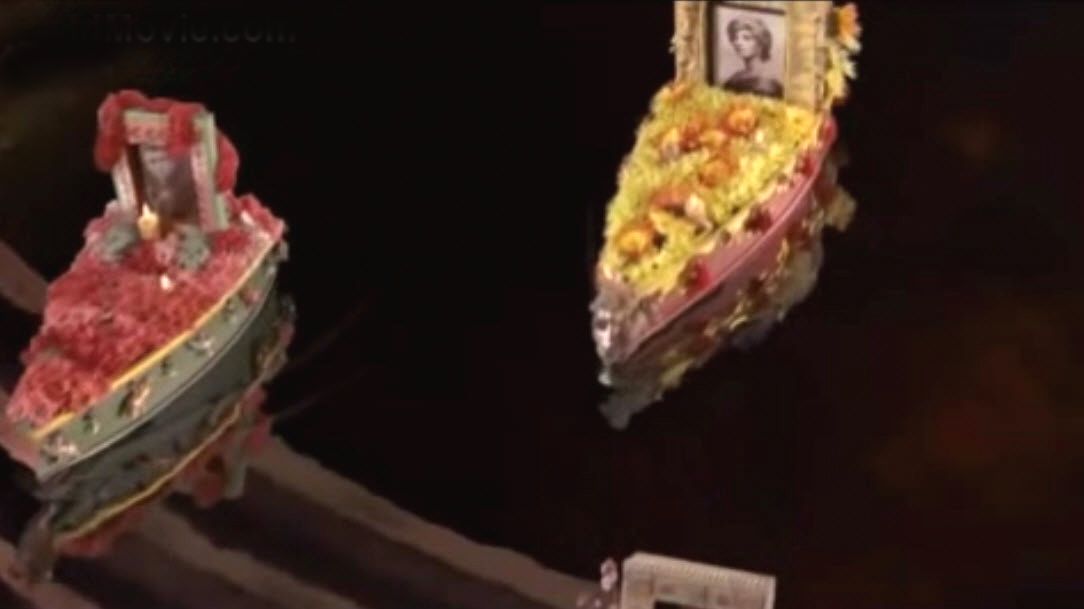
In an eerie scene where Tony (played by Johnny Depp) guides a rich woman through her fantasy world, three boats appear bearing the pictures of Rudolph Valentino, James Dean and Princess Diana, three public figures who died prematurely.
Tony urges the rich woman to follow their path and to embark on a gondola bearing the head of Anubis, the god of the Dead. The woman sees the pictures and says:
“All these people … they’re all dead.”
Tony replies:
“Yes … but immortal nevertheless. They won’t get old or fat. They won’t get sick or feeble. They are beyond fear because they are … forever young. They’re gods … and you can join them.”
He then adds:
“Your sacrifice must be pure.”
All of this is said by Johnny Depp, the actor who replaced Heath Ledger after his premature death. The least I can say is this: strange coincidence. The esoteric meaning of the scene alludes to the dying of the old self in order to give birth to the new, spiritual self. Spiritually, however, this metamorphosis is however obtained through self-sacrifice and personal work, not by dying young. The public figures on the boats all died in “mysterious” circumstances. What is the relation?
Occultists believe that occult rituals, by definition, must have an audience. The greater the number of witnesses, the better, as they give those who execute the rituals more power and potency. Was Ledger’s death a mega-ritual?
In Conclusion
Many movies in Heath Ledger’s career have revolved around occult themes, whether The Order, The Brothers Grimm or The Imaginarium of Dr Parnassus. Despite this last movie’s positive moral lesson, it almost seems to have been written with prior knowledge of his death. There is a definite aura surrounding this actor and the mysterious circumstances around his death only further this feeling. Terry Gilliam said about Heath:
“Everyone said he died young, but I think he was about 150 when he died. This was not a kid. There was wisdom there. I didn’t know where it came from – none of us knew – but everybody that was close to him says the same thing.”
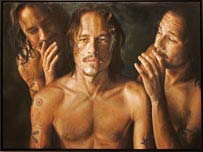
People close to Ledger observed a strange transformation in him during the filming of Batman Forever. Shortly before his death, he posed for this artwork painted by his friend Vincent Fantauzzo.
The artist depicted Heath surrounded by two ‘mind spirits’ whispering into his ears. Vincent said the whispering spirits represent Heath’s inner thoughts. What was going on in his head? Was he victim of mind control or possession? Was he sacrificed by an occult brotherhood? No positive answer can be given at this point and time. All I can say for now is Heath Ledger’s last line in the film, and his last ever as an actor: Don’t shoot the messenger.